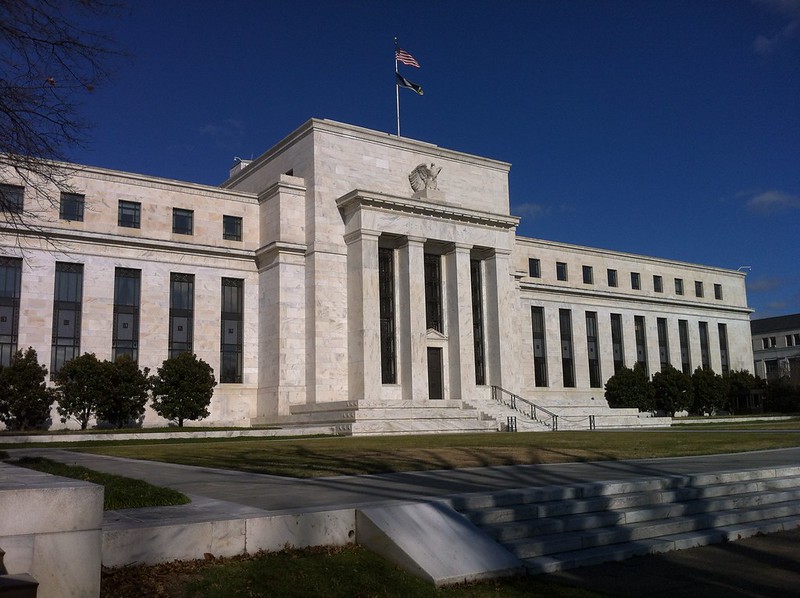
Kevin Warsh leads his first FOMC meeting as Fed Chair. With a divided committee and a US-Iran deal altering the inflation outlook, markets await his signal on the future of rate policy.
Kevin Warsh steps up to the podium on Wednesday for his first Federal Open Market Committee meeting as the 17th Chair of the Federal Reserve — and the job description has changed dramatically in the 72 hours since the weekend.
When Warsh was sworn in on May 22, he inherited a 4.2% inflation print, a divided committee, a hawkish Wall Street, and a president demanding rate cuts.
He walks into June 16–17 with all of that still intact, plus a U.S.-Iran peace deal that just collapsed the primary driver of the inflation overshoot and handed him a credible exit from the hawkish corner.
How he uses that exit could be the most important policy communication event of 2026.
The rate decision itself is a non-event. The federal funds target stays at 3.50–3.75%; CME FedWatch prices a 99.4% probability of no change.
Source: CME FedWatch Tool
What traders are actually pricing on Wednesday afternoon is the statement language, the dot plot, and the first 45 minutes of Warsh's press conference — three things that could move S&P, gold, the 10-year yield, and the U.S. dollar simultaneously in either direction.
The Setup: A Historically Divided Committee
Warsh does not inherit a unified Fed. The April 29 meeting, Powell's final — produced four dissents, the most divided outcome in the modern FOMC era.
Three of those dissents came from Cleveland's Beth Hammack, Minneapolis's Neel Kashkari, and Dallas's Lorie Logan, all of whom voted to hold rates but objected to the retention of an easing bias in the statement. A fourth dissent came from Governor Stephen Miran, who voted for an immediate 25bp cut, though Miran has since left the FOMC.
The easing bias language in question reads: "In considering the extent and timing of additional adjustments to the target range for the federal funds rate, the Committee will carefully assess incoming data, the evolving outlook, and the balance of risks."
The word "adjustments" is interpreted as implying a cut because the last actual adjustments were cuts. Markets have read it as a green light for eventual easing for three consecutive meetings. A majority of FOMC members, per the April minutes, now disagree with that interpretation remaining in the statement.
The easing bias is going. That much is near-consensus across Wall Street. J.P. Morgan Wealth Management Chief Investment Strategist Phil Camporeale stated: "There will likely be an explicit move away from a bias toward easing to a neutral stance on rates." LPL Financial's chief economist Jeffrey Roach put it identically: "Expect the Fed to remain on hold while removing any bias toward additional easing."
The market-moving question is what replaces it and what Warsh says at the podium.
The Iran Wildcard: A Lifeline Warsh Didn't Expect
The recent U.S.-Iran peace deal has dramatically altered the FOMC's inflation outlook just ahead of Wednesday's meeting.
While May’s headline CPI spiked to 4.2% and PPI climbed to 6.5% due to a conflict-driven 40.5% surge in gasoline prices, core CPI remained a far more benign 2.9%. With Brent and WTI crude now tumbling back toward pre-conflict levels below $83 and $80, the energy component is poised to drag June's inflation data sharply lower, reversing the headline shock.
This sudden oil collapse creates a pivotal dilemma for Kevin Warsh and the Fed.
While the upcoming Summary of Economic Projections will look hawkish because it relies on May's lagging data, the peace deal strongly supports a transitory framing for the recent price spike.
Backed by the stable core CPI reading, Warsh has the narrative ammunition to argue that inflation isn't structurally entrenched, likely justifying a less aggressive stance than the raw May figures would otherwise demand.
What to Watch: The Three-Tier Framework
Tier 1 — The Statement Language
The removal of the easing bias is the baseline. What replaces it determines the tone. Options range from a clean neutral ("the Committee will assess incoming data") to a two-sided formulation that explicitly acknowledges the possibility of either cuts or hikes.
A two-sided statement would be meaningfully hawkish and would likely push the 10-year yield higher and knock S&P 500 and gold lower. A clean neutral is largely priced and should generate limited reaction.
Tier 2 — The Dot Plot and SEP
This is where the surprises are most likely. The March dot plot showed one cut in 2026. Given everything that has happened since, 4.2% CPI, a hawkish April dissent cluster, a new Chair with an inflation-discipline mandate, the median dot is expected to shift from one 2026 cut to zero, and potentially show one hike pencilled in for H2.
But there's an additional wildcard Warsh himself has introduced: the Financial Times reported that he may begin rolling back forward guidance as early as this meeting, potentially scrapping the dot plot's forward rate forecasts entirely or presenting them in an amended form.
As Kraken's economic brief noted, "whether the dot plot appears at all, and in what form, is now one of the biggest questions heading into June 17." A dot plot that's been stripped of specificity is inherently dovish by omission — it removes the market anchor that would otherwise signal hikes.
Tier 3 — Warsh's Press Conference
This is Warsh's first major public appearance as Chair in a formal policy context, and his communication style is expected to diverge from Powell's. He has historically been skeptical of granular forward guidance and verbose post-meeting communications.
Barclays notes he is likely to be shorter, less prescriptive, and more conditional in his language, a style that could be interpreted as either disciplined or evasive, depending on the market's risk appetite in the room.
The critical sentence to listen for: does Warsh acknowledge that the Iran deal materially reduces the upside risk to the inflation outlook?
If he does, even carefully, even conditionally, it opens the door to the interpretation that the Fed's next move is still a cut, and that Wednesday's hawkish pivot is a one-time recalibration rather than the start of a hiking cycle.
That interpretation is bullish S&P, bullish gold, and bearish DXY.
Market Impact Matrix
Table Created by Zain Vawda
US Dollar Index (DXY)
The four-hour chart of the U.S. Dollar Index Futures reflects a recent shift in market momentum following a strong bullish rally that peaked above the 100.200 level earlier in June.
Since hitting that peak, the index has undergone a corrective pullback, breaking below the 100-day Moving Average (MA) which is currently tracking at 99.399. At the time of this chart's capture, the price is trading around 99.265, struggling to reclaim that 100 MA line, which may now act as immediate overhead technical resistance.
US Dollar Index Four-Hour Chart, June 16, 2026
Source: TradingView
Despite this short-term bearish pressure, the broader structure retains an upward bias as the price action remains safely above the ascending 200-day MA located lower at 98.949.
This 200 SMA serves as a crucial dynamic support zone that buyers will look to defend to prevent a deeper structural trend reversal.
Meanwhile, looking at the Relative Strength Index (RSI) which is hovering at 40.003 after recently printing a blue "PIVOT" low near the oversold threshold of 30.
This RSI reading indicates that while sellers currently maintain control of the immediate price action, the aggressive downward momentum is beginning to stabilize, potentially setting up a consolidation phase or a minor technical bounce as the market tests these key dynamic support boundaries.